
10 Great Things to Know About Lake Beulah in Winter
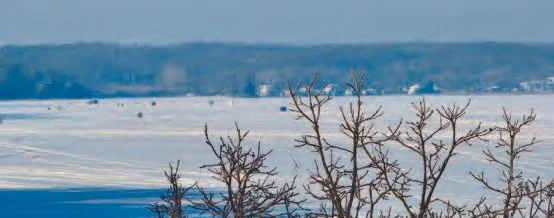
Adapted from an article by Ted Rulseh in Lake Tides, vol.46, No.1 Winter/Spring 2021 from the Wisconsin Lakes Partnership
Lake Beulah is a very different place in winter, but is still a living system. Look closely and you can observe the processes by which the ice forms and ultimately disappears with spring. Meanwhile, aquatic creatures change their habits to make it through until spring. Here are ten things you may not know about frozen Lake Beulah.
1. IT STARTS WITH STEAM… Look out on the lake on a very cold October morning and you may see ‘steam’ rising from the water. A sure sign the water is cooling. this steam fog, or ‘water smoke’ forms when warm, moist air just above the water condenses into droplets when it meets the colder, drier air above.
2. ICE REQUIRES COLD STILLNESS… Lake Beulah won’t freeze during windy days. Wave action constantly fractures tiny ice crystals as they form. In these conditions, the water can actually supercool, remaining liquid below the freezing point of 32ºF. Then, along comes a cold, windless night and voila!. The lake is covered with a thin sheet of ice.
3. LAKE BEULAH WATER LAYERS… Beneath the ice, the water has an interesting profile. The warmest (~40º), densest water lies at the bottom. The coldest (~32º), least dense water lies right under the ice. The ice itself, which expands about 10% from its liquid state, floats because it is least dense of all.
4. LAKE BEULAH IS RICH IN OXYGEN WHEN IT FIRST FREEZES… Fish and other water creatures depend on a supply of oxygen to make it through winter. Fortunately, beneath the new ice, the lake hold more oxygen than at any other time of the year. At 32ºF, water holds almost twice the oxygen it can hold at 80ºF.
5. WATER CREATURES NEED LESS OXYGEN IN WINTER… During this time of year, the metabolism of cold-blooded fish, frogs, mollusks, and other critters slows way down. They move more slowly, or not at all, thereby conserving the supply of oxygen trapped beneath the ice with them.
6. DON’T WORRY ABOUT LAKE BEULAH ‘BOOMING’… During winter, the lake can really make some noise, which seems especially pronounced on really cold nights. The eerie sounds result from ice expanding and contracting with temperature changes. Booming and cracking do not mean ice is weakening.
7. ICE IS REALLY A COLLECTION OF CRYSTALS… Though we think of ice as a solid substance akin to glass, in reality it consists of crystals organized into hexagonal shapes tightly packed together. These crystals grow from the surface downward. This structure is revealed as ice deteriorates in spring as the bonds between the crystals break down into loosely connected ‘candles’. In this condition, the ice is extremely weak and dangerous to walk upon.
8. SCIENTISTS DISAGREE ON WHY ICE IS SLIPPERY… The old notion that pressure melts ice to make it slippery has been discarded in favor of two new theories. One is that friction melts the ice. The other is that ice is inherently slippery due to a tiny liquid film that is always present.
9. ICE IS TOUGH & FRAGILE… Its ‘fracture toughness’ is about 1/10 that of window glass, so it breaks quite easily. But when it comes to bending under load, its tensile (flexural) strength is about the same as a pine board across the grain. The WIDNR has the following guidelines for clear ice safety. 4” - Ice fishing on foot… 5” - Snowmobile…100+” - Godzilla.
10. ICE MELTS FROM THE BOTTOM UP… As the weather warms and snow melts off the ice surface, the sun’s rays penetrate it and warm the water below, while also warming areas of open water near shore. Warm air above the ice contributes to the thaw, but it’s the warming water below the ice that really does the trick.